3 Key Takeaways from OSHA's Updated Heat NEP (And What it Means for Your Safety Program)
Has OSHA's National Emphasis Program (NEP) for Outdoor and Indoor Heat-Related Hazards had any real impact on worksite safety programs since launching in 2022?
Short answer: Absolutely.
"We were seeing maybe 700 inspections of heat over a couple year period, whereas now we've seen over 7,000," says Lexi Hagler, Heat Stress Product Manager at Ergodyne. "It's real."
It’s real and it's evolving, with an updated and extended (through 2031) version of the NEP announced in the spring of 2026.
The revised guidance gives employers a much clearer picture of what inspectors are looking for and an opportunity to evaluate their own programs before the safety cops come a-knockin’ at their trailer door.
Here are the three biggest takeaways from the NEP update…
Takeaway #1: Compliance is an open-book test
When OSHA launched the Heat NEP in 2022, one of its primary goals was to collect data, increase awareness and focus enforcement efforts on industries with the greatest heat-related risks.
That's all still true.
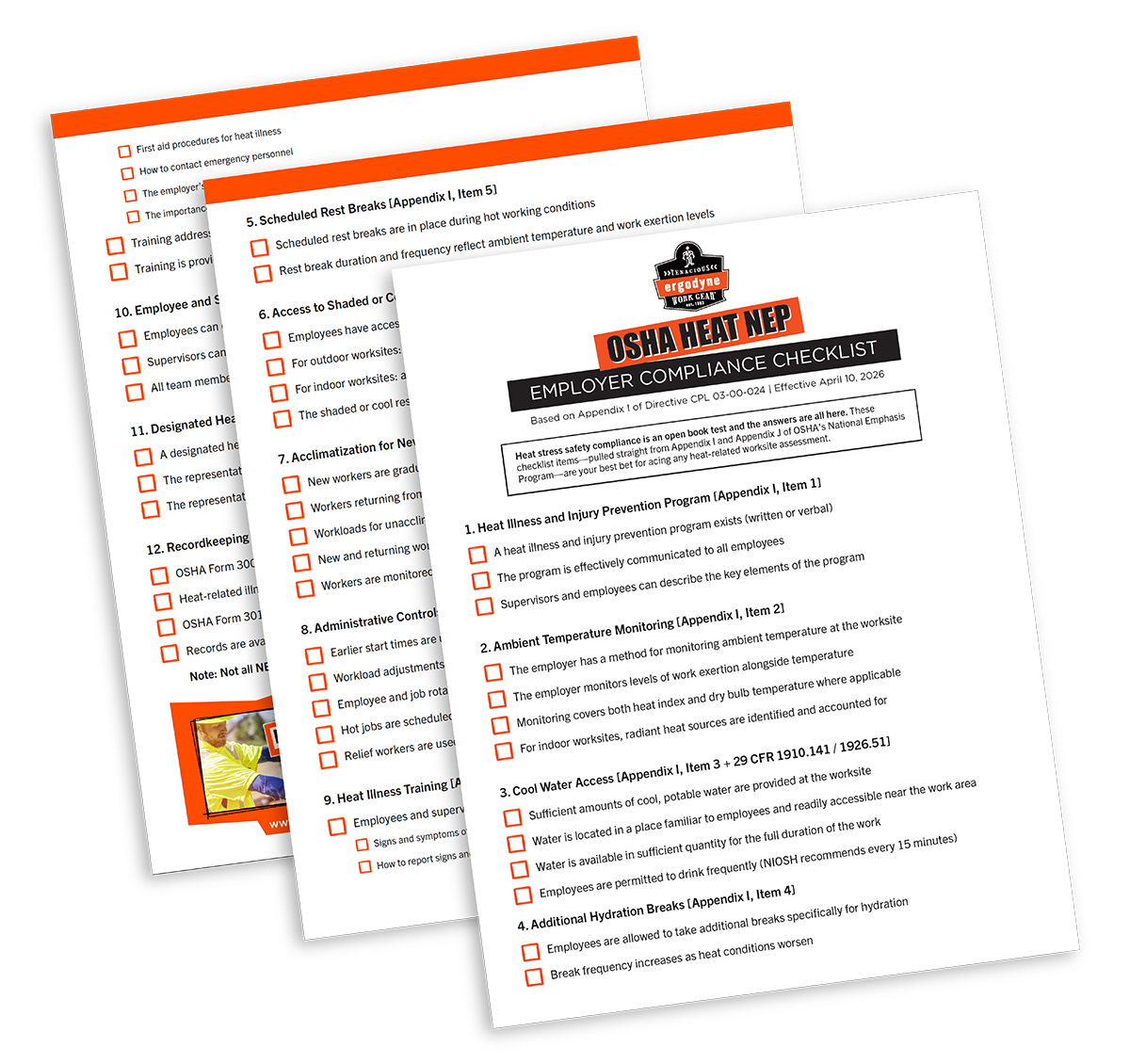
Additionally, the updated NEP now brings clearer inspection and enforcement expectations by providing OSHA compliance officers with more specific guidance on what to look for, including an 11-question Heat Program Evaluation (Appendix I) that serves as a checklist for assessing an employer's heat illness prevention program.
The good news for employers is that this very same guidance can be used proactively to build and bolster their own programs.
Rather than waiting for an inspection to identify gaps, safety managers can evaluate their own programs by cross-referencing Appendix I and following the exact same criteria OSHA inspectors are now using.
Takeaway #2: Go beyond water, rest and shade
Water, rest and shade remain the foundation of heat illness prevention. But the updated NEP makes it clear that inspectors are evaluating much more than that.
OSHA wants to understand whether employers have a comprehensive heat illness prevention program. That includes how heat hazards are identified, how workers are trained, whether environmental conditions are monitored, how new employees are acclimatized and whether someone is responsible for managing the program.
One of the strengths of the updated NEP is that it recognizes heat illness prevention isn't one-size-fits-all.
A road construction crew has different risks than a warehouse employee. A manufacturing facility with radiant heat sources requires different controls than an outdoor utility crew.
As Hagler explains, "Every industry and every job and every location is going to have different challenges. As much as we want a one-size-fits-all solution, this is still very personal to each job site and each industry."
That same principle applies to training and acclimatization.
Many of the recommendations in the updated NEP aren't new, but they remain essential. Training—in a language everybody understands—continues to be one of OSHA's highest priorities. Employees should understand the signs and symptoms of heat illness, know how to report concerns and be prepared to respond if a coworker experiences a heat-related emergency.
Acclimatization also remains a key component of an effective heat illness prevention program, particularly for new employees, workers returning from time away or employees traveling to different climates. As Hagler notes, many industries rely on mobile workforces that regularly move between jobsites and environments, making acclimatization an important consideration for employers.
OSHA's updated and extended Heat National Emphasis Program (NEP) gives employers a clearer picture of what inspectors are evaluating when it comes to heat illness prevention. In this episode, Ergodyne's heat stress expert Lexi Hagler breaks down the key updates and practical steps safety managers can take to assess their programs before OSHA does.
- What changed in OSHA's updated Heat NEP and why it matters for employers?
- The key elements OSHA expects to see in an effective heat illness prevention program
- How to use the NEP to identify gaps and strengthen compliance efforts before an inspection or incident occurs
Takeaway #3: If it’s not documented, it doesn’t exist
Perhaps the biggest practical takeaway from the updated NEP is this: If it's not documented, it doesn't exist.
"Most people are probably doing a lot of these things already," says Hagler about heat illness precautions. "It's truly just writing it down and saying, yep, here are the steps that we're taking."
Many employers are already providing water, allowing breaks and giving workers places to cool down. What's often missing is the documentation that ties those efforts together into a formal heat illness prevention program.
Written procedures, training records, acclimatization plans and clearly assigned responsibilities not only drive compliance but help create consistency and accountability throughout an organization.
Does your program check all the boxes?
The updated Heat NEP provides the clearest framework yet for evaluating whether employers are putting long-standing best practices into action. We've turned those evaluation points into a practical checklist you can use to review your own program, identify potential gaps and prioritize improvements to keep your crew safe in the heat.